The Colonial History of Massachusetts, 1620–1775
This post is the second in a series of 13 that will provide a history of the American colonial period. Click here for a look at the colonial history of Virginia.
The story of colonial Massachusetts is one of faith and pragmatism, aspiration and anxiety, communal discipline and individual resistance. From the landing of the Pilgrims at Plymouth in 1620 to the outbreak of armed rebellion against British authority in 1775, Massachusetts developed into the most populous, economically dynamic, and politically influential colony in New England. Its experience shaped American religious culture, political thought, and revolutionary ideology in ways that reverberated far beyond its borders.
This essay traces the major phases of Massachusetts’ colonial history: the founding of Plymouth and Massachusetts Bay, the evolution of Puritan society, relations with Native peoples, economic growth and imperial conflict, and the colony’s gradual transformation into the epicenter of American resistance.
Plymouth Colony and the Pilgrim Experiment (1620–1691)

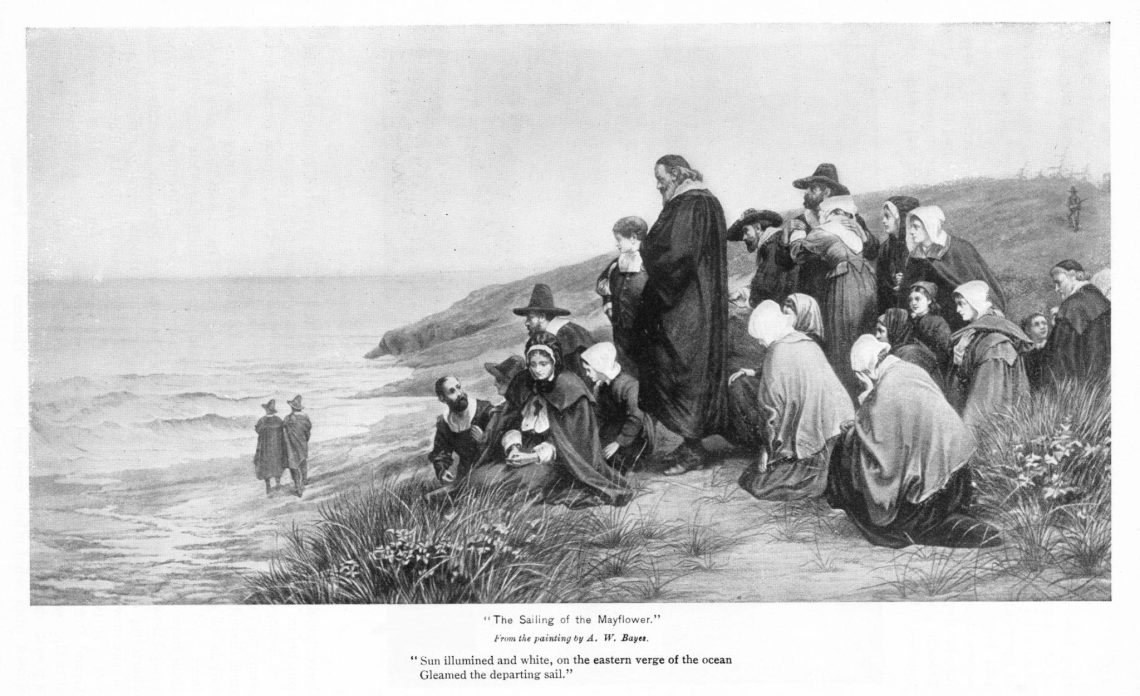
Massachusetts’ colonial story begins with the founding of Plymouth Colony in December 1620. The settlers who arrived aboard the Mayflower were Separatist Puritans—later known as Pilgrims—who sought to escape religious persecution and build a godly community based on their understanding of Scripture.
Before disembarking, the male passengers drafted and signed the Mayflower Compact, a brief but significant agreement that established self-government based on the consent of the governed. While not democratic in a modern sense, the Compact set an early precedent for political legitimacy rooted in collective agreement rather than royal decree.
The early years of Plymouth were harsh. Disease and exposure killed nearly half the colonists during the first winter. Survival depended heavily on assistance from Native peoples, particularly members of the Wampanoag Confederacy. The Wampanoag leader Massasoit forged a crucial alliance with the settlers, providing food aid and local knowledge that enabled the colony to endure.
Plymouth remained small and relatively poor throughout its existence. Its importance lay less in economic power than in symbolic legacy: it became a touchstone for later generations as a founding moment of English America rooted in covenant, community, and moral purpose.
The Founding of Massachusetts Bay (1630)
A far more consequential settlement emerged a decade later with the establishment of the Massachusetts Bay Colony. Unlike Plymouth, Massachusetts Bay was founded under a royal charter and backed by wealthy investors. Beginning in 1630, thousands of Puritans migrated to New England during what became known as the Great Migration.

The colony’s most influential early leader was John Winthrop, who envisioned Massachusetts as a moral exemplar. In his famous sermon aboard the Arbella, Winthrop described the colony as a “city upon a hill,” watched by the world and bound by covenant to God and one another.
Massachusetts Bay was organized as a theocratic society. Church membership was required for full political participation, and civil authorities enforced religious conformity. Towns were tightly regulated communities where social order, moral behavior, and communal responsibility were paramount.
Boston quickly emerged as the colony’s political and economic center. Its natural harbor facilitated trade, while its institutions—churches, schools, and courts—set patterns emulated throughout New England.
Puritan Society and Dissent
Puritan Massachusetts was cohesive but not uniform. Almost from the beginning, dissent challenged the colony’s leadership and tested its commitment to religious unity.
One of the earliest controversies involved Roger Williams, who argued for the separation of church and state and criticized the colony’s treatment of Native peoples. Banished in 1636, Williams went on to found Rhode Island, which became a haven for religious toleration.
Another major challenge came from Anne Hutchinson, whose teachings questioned clerical authority and emphasized individual spiritual revelation. Her trial and exile in 1637 underscored the limits of Puritan tolerance and the colony’s determination to preserve doctrinal unity.
Despite its rigidity, Massachusetts invested heavily in education. In 1636, the colony founded Harvard College, reflecting the Puritan belief that an educated ministry was essential to a godly society. Literacy rates in Massachusetts became among the highest in the Atlantic world.
Expansion and Conflict with Native Peoples
As Massachusetts grew, English settlement expanded into Native lands, straining relations with Indigenous communities. Early cooperation gradually gave way to competition over land, resources, and political authority.
The most devastating conflict was King Philip’s War (1675–1676), named for the Wampanoag leader Metacom, known to the English as King Philip. The war pitted a coalition of Native peoples against English settlers across New England.
King Philip’s War was brutal and destructive. Entire towns were burned, thousands were killed, and Native resistance was decisively crushed. For Massachusetts, the war secured English dominance in the region but at enormous cost, leaving lasting scars on both Native and colonial societies.
Royal Authority and the Loss of Autonomy
By the late seventeenth century, Massachusetts’ independence increasingly concerned English authorities. The colony’s leaders often ignored or evaded imperial regulations, including the Navigation Acts that governed colonial trade.
In 1684, the English crown revoked the Massachusetts Bay charter, and the colony was incorporated into the Dominion of New England. Under the rule of Edmund Andros, local self-government was curtailed, taxes were imposed without consent, and religious toleration was expanded in ways Puritans found threatening.
The overthrow of James II during England’s Glorious Revolution in 1688 sparked rebellion in Boston. Andros was arrested, and Massachusetts effectively reclaimed local control. In 1691, a new royal charter united Plymouth and Massachusetts Bay into the Province of Massachusetts Bay, though with reduced autonomy and increased royal oversight.
Economy, Trade, and Atlantic Connections
During the eighteenth century, Massachusetts developed a diverse and resilient economy. Agriculture supported local communities, but trade drove growth. Boston merchants engaged in Atlantic commerce, exporting fish, lumber, and rum while importing manufactured goods.
Shipbuilding flourished along the Massachusetts coast, and the colony became a major hub of maritime labor. Although Massachusetts was not a plantation colony, slavery existed, particularly in urban households and maritime industries.
Economic life also fostered a politically aware populace. Merchants, artisans, and farmers closely monitored imperial policies that affected trade, taxation, and local governance. This economic consciousness laid groundwork for later resistance.
Religion and the Great Awakening
Religious life in Massachusetts evolved over time. By the early eighteenth century, Puritan orthodoxy had softened, and church membership requirements were relaxed. Many clergy worried that spiritual fervor was waning.
The Great Awakening of the 1730s and 1740s reinvigorated Protestantism. Preachers like Jonathan Edwards emphasized emotional conversion and personal faith.
The Great Awakening divided congregations but democratized religious authority. Ordinary believers felt empowered to judge doctrine for themselves, reinforcing habits of questioning hierarchy that later influenced political attitudes.
Massachusetts and Imperial War
Massachusetts played a major role in Britain’s imperial wars, particularly the conflicts with France in North America. Colonial militias fought alongside British troops in wars culminating in the French and Indian War.
The war’s outcome secured British dominance in North America but left Britain deeply in debt. Efforts to recover costs through colonial taxation would profoundly affect Massachusetts.
The Road to Revolution (1763–1775)
After 1763, relations between Massachusetts and Britain deteriorated rapidly. Parliamentary measures such as the Stamp Act and Townshend Duties were perceived as violations of colonial rights, particularly taxation without representation.
Boston emerged as the center of resistance. Organizations like the Sons of Liberty mobilized protests, while colonial newspapers articulated arguments grounded in English constitutional tradition and natural rights.
Tensions exploded in the Boston Massacre, when British soldiers fired on civilians, killing five. Although order was restored temporarily, mistrust deepened.
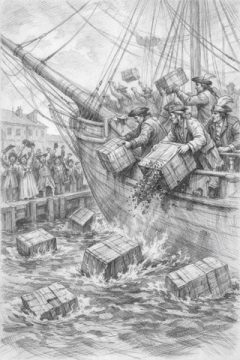
In 1773, the Boston Tea Party dramatized colonial defiance. Parliament responded with punitive Coercive Acts, which Massachusetts residents denounced as intolerable.
When British troops marched to seize colonial arms in April 1775, they were met by Massachusetts militia at Lexington and Concord. The ensuing battles marked the beginning of the American Revolutionary War.
Conclusion
Between 1620 and 1775, Massachusetts evolved from a fragile religious experiment into a mature and influential colony at the heart of American resistance to British rule. Its Puritan foundations shaped a culture of moral seriousness, education, and civic responsibility. Its conflicts—with dissenters, Native peoples, royal governors, and Parliament—fostered political awareness and institutional resilience.
By the time shots were fired at Lexington and Concord, Massachusetts had developed not only the capacity to resist imperial authority but also a powerful narrative of liberty rooted in covenant, community, and conscience. That legacy would help define the emerging United States and ensure Massachusetts a central place in American history.


You May Also Like
The History of the Virginia Colony, 1607–1775
Empire on the Hudson: The Colonial History of New York, 1608–1775