Shadows and Signals: Espionage in the Cold War World
I have always thought of the Cold War less as a single conflict than as a long, anxious conversation conducted in whispers. It was a war without battle lines, without formal declarations, and—most strikingly—without a clear beginning or end. Instead, it unfolded in shadows: in embassy corridors, anonymous apartments, university common rooms, and government offices where files moved quietly from one hand to another. Espionage was not a side story of the Cold War; it was one of its central languages.
From the late 1940s until the collapse of the Soviet Union in 1991, intelligence gathering shaped diplomacy, military planning, domestic politics, and public imagination. Espionage influenced how governments perceived one another and, just as importantly, how they feared one another. The possibility that an enemy agent might already be inside the room—listening, copying, waiting—defined the psychological atmosphere of the era.
In this essay, I want to offer an overview of Cold War espionage as a system and a culture, and then slow down to examine three particularly revealing cases. These cases matter not because they are sensational, but because each illuminates a different dimension of Cold War spying: ideology, loyalty, secrecy, and the heavy cost of living a double life.
Espionage as a Cold War System
Unlike earlier periods of intelligence work, Cold War espionage operated in a world structured by ideology. The conflict between the United States and the Soviet Union was not merely geopolitical; it was existential. Each side believed that the other represented a fundamentally dangerous vision of the future. Intelligence agencies did not simply gather information—they sought reassurance, confirmation, and advantage in a system where miscalculation could mean catastrophe.
Technological change intensified this pressure. Nuclear weapons made surprise and secrecy terrifyingly consequential. A misjudgment about missile placement, bomber readiness, or scientific capacity could trigger escalation on a scale never before imagined. As a result, espionage became professionalized, bureaucratic, and relentless. Intelligence services grew larger, more specialized, and more deeply embedded in the machinery of state.
Yet for all its institutional power, espionage still depended on individuals. Files did not walk themselves across borders. Messages did not encode or decode themselves. Human beings—often brilliant, often flawed—made decisions that reshaped history. It is in those decisions that Cold War espionage becomes most human, and most tragic.
Case One: Alger Hiss and the Fragility of Trust
The case of Alger Hiss occupies a peculiar place in Cold War history. It was not the first espionage scandal of the era, but it was one of the most politically explosive, in part because it unfolded in public view at precisely the moment when Americans were trying to understand what the Cold War even was.
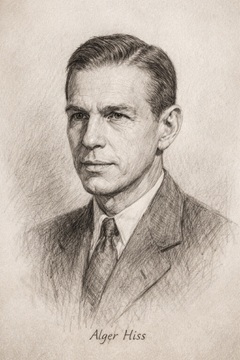
Hiss was not a shadowy figure lurking on the margins of power. He was an elite insider: a Harvard-educated lawyer, a senior State Department official, and a participant in the Yalta Conference and the founding of the United Nations. He embodied the New Deal–era faith in expertise, internationalism, and professional governance. That was precisely why the accusation against him was so destabilizing.
In 1948, former Communist courier Whittaker Chambers accused Hiss of having passed classified documents to Soviet intelligence in the 1930s. Hiss denied the charge categorically, and what followed was less a trial than a national drama. Congressional hearings, press coverage, and political maneuvering transformed the case into a referendum on loyalty, class, and credibility.
Legally, the outcome was narrow: Hiss was convicted of perjury, not espionage, because the statute of limitations for spying had expired. Historically, the case remained contested for decades. Supporters insisted that Hiss was the victim of a witch hunt fueled by anti-Communist hysteria. Critics argued that the evidence—especially the typed documents known as the “Pumpkin Papers”—pointed unmistakably to guilt.
The release of Soviet archival material in the 1990s, including decrypted intelligence cables, shifted scholarly opinion. While debate continues, most historians now conclude that Hiss did serve as a Soviet source, even if the precise scope of his activity remains uncertain.
What makes the Hiss case so revealing is not only the question of guilt, but the way it shattered assumptions. The case demonstrated that espionage was not confined to radicals or outsiders. It could involve polished professionals who believed—rightly or wrongly—that they were serving a higher moral purpose. In addition, it showed how espionage accusations could corrode public trust, turning uncertainty itself into a political weapon.
The Ideological Roots of Cold War Spying
To understand why people spied during the Cold War, we have to move beyond caricatures of greed or coercion. Many Cold War spies were motivated by ideology, particularly during the 1930s and 1940s, when the Soviet Union appeared to some as a bulwark against fascism and economic collapse.
This ideological dimension complicates easy moral judgments. Some individuals genuinely believed that sharing information would prevent war or promote global stability. Others became disillusioned but felt trapped by earlier commitments. Still others rationalized their actions as balancing an unfair world order.
Espionage, in this sense, was not only about secrets. It was about belief—about competing visions of justice, power, and historical destiny. No case illustrates this better than the next one.
Case Two: Kim Philby and the Betrayal from Within
If Alger Hiss symbolized the fear of infiltration, Kim Philby represented something even more unsettling: betrayal at the highest levels of intelligence itself.
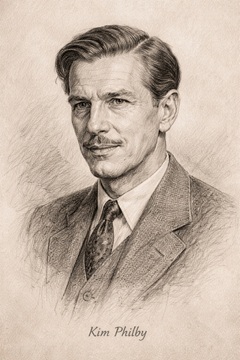
Philby was a senior officer in British intelligence and, at one point, the head of counter-espionage against the Soviet Union. He was also, for decades, a loyal agent of Soviet intelligence. Along with other members of the so-called “Cambridge Five,” Philby had been recruited in the 1930s, when communism seemed to offer a compelling alternative to fascism and imperial decline.
What distinguishes Philby’s case is not merely the damage he caused—though that damage was immense, leading to the exposure and deaths of numerous Western agents—but the extraordinary length of time he remained undetected. His accent, education, and social connections shielded him. He fit perfectly into the image British intelligence had of itself.
Philby’s story forces us to confront the role of class and culture in espionage. Intelligence services often trust people who resemble themselves. That trust can become blindness. Philby exploited not just security gaps, but social assumptions—about who looked like a traitor and who did not.
When Philby finally defected to the Soviet Union in 1963, the sense of betrayal was profound. British intelligence was humiliated, and Western confidence in its own institutions suffered a serious blow. Philby himself died in Moscow, disillusioned and increasingly marginalized, a reminder that even successful spies rarely find peace.
Espionage and the Machinery of Fear
By the 1950s, espionage had become inseparable from public fear. Governments warned of internal enemies. Media sensationalized trials and defections. Ordinary citizens wondered whether colleagues, neighbors, or even family members might be hiding dangerous secrets.
This atmosphere was not accidental. Espionage scandals reinforced the perception that the Cold War was everywhere—at work, at home, in schools and laboratories. Intelligence agencies benefited from this climate, as it justified expanded budgets, secrecy, and authority.
But fear also produced distortions. Not every accusation was true. Not every suspect was guilty. The line between vigilance and paranoia was often thin, and it was crossed more than once.
Case Three: Julius and Ethel Rosenberg and the Price of Secrecy
No Cold War espionage case better captures the era’s moral intensity than that of Julius and Ethel Rosenberg. Arrested in 1950 and executed in 1953 for passing atomic secrets to the Soviet Union, the Rosenbergs became symbols—of treason to some, of injustice to others.
The case revolved around the transfer of information related to nuclear weapons, at a time when the United States was struggling to maintain its atomic monopoly. The fear was stark: if the Soviets obtained the bomb, global power would shift irrevocably.
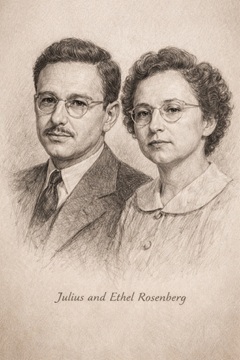
Evidence presented at trial indicated that Julius Rosenberg had been involved in espionage networks, particularly through contacts in the scientific community. The case against Ethel Rosenberg was weaker and rested largely on testimony later shown to be deeply problematic. Nonetheless, both were sentenced to death.
What makes the Rosenberg case so haunting is not only the severity of the punishment, but the way it compressed Cold War anxieties into a single moral decision. Were the executions an act of justice or an act of fear? Did they deter espionage—or did they demonstrate how far the state was willing to go when terrified?
Decades later, declassified material suggests that Julius Rosenberg was indeed involved in espionage, though his contribution may have been exaggerated. Ethel’s role remains far more ambiguous. The case continues to trouble historians precisely because it reveals how espionage cases are shaped not only by evidence, but by emotion, politics, and the desire for certainty in an uncertain world.
Living the Double Life
One of the quiet truths of Cold War espionage is that very few spies lived glamorous lives. The reality was isolation, constant anxiety, and moral fragmentation. Maintaining a cover meant lying not just to governments, but to spouses, children, and friends.
Many spies reported that the hardest part was not fear of arrest, but the erosion of self. Who were they, really? The loyal citizen or the secret agent? The public self or the private one? Espionage demanded a divided identity, and that division often carried a heavy psychological cost.
Espionage and Historical Memory
Today, Cold War espionage fascinates us partly because it seems distant, almost theatrical. Code names, dead drops, microfilm—they belong to a world that feels analog and slow compared to modern digital surveillance. But the underlying questions remain painfully relevant.
How much secrecy is necessary for security? How easily does secrecy become abuse? And how should societies judge individuals who act in the name of ideology rather than nation?
Espionage during the Cold War reminds us that history is rarely clean. It is made by people who believe they are choosing the lesser evil, only to discover that evil does not stay neatly contained.
Conclusion: What the Cold War Still Teaches Us
When I study Cold War espionage, I am struck less by its cleverness than by its vulnerability. Intelligence systems were powerful, but fragile. They depended on trust, and trust could be broken by belief, ambition, or despair.
The cases of Alger Hiss, Kim Philby, and the Rosenbergs show us different faces of the same phenomenon: the collision between ideology and loyalty in a world terrified of its own destruction. They remind us that espionage is not just about secrets kept, but about societies afraid of what they might not know.
The Cold War may be over, but the shadows it cast still linger. And as long as power and fear coexist, someone will always be listening from the other side of the wall.


You May Also Like
Faith, Fear, and the Secret State: The Ideological Roots of Cold War Espionage