Rewiring the Brain: Neuroplasticity and the Art of Positive Habit Formation
For much of the twentieth century, scientists believed the adult brain was largely fixed—its structure set in childhood, its pathways mostly immutable. You were born with a certain amount of intelligence, temperament, and ability, and while you could learn new facts, the deeper architecture of the brain was thought to be essentially permanent. That view has collapsed. Modern neuroscience tells a far more hopeful and demanding story: the brain is plastic. It changes with experience, attention, and repetition. And nowhere is that truth more powerful—or more practical—than in the formation of habits.
Neuroplasticity explains why habits work. Habit science explains how plasticity plays out in daily life. Together, they offer a framework for understanding how small, repeated actions can reshape not just behavior, but identity itself. This essay explores the science of neuroplasticity, the mechanics of habit formation, and the practical strategies for building positive habits that endure.
What Neuroplasticity Really Means
Neuroplasticity refers to the brain’s ability to change its structure and function in response to experience. At a cellular level, this involves neurons forming new connections (synapses), strengthening existing ones, or pruning away those that are no longer used. At a systems level, it can mean entire brain networks reorganizing themselves to perform tasks more efficiently.
The foundational insight behind neuroplasticity is often summarized by a phrase attributed to Donald Hebb: “Neurons that fire together wire together.” When a particular pattern of neural activity occurs repeatedly—say, practicing a musical scale, responding calmly to stress, or reaching for your phone when bored—the brain reinforces that pattern. The signal becomes easier to activate next time.
Plasticity operates across the lifespan. While children’s brains are especially malleable, adult brains remain capable of significant change. Stroke victims can relearn lost skills. London taxi drivers show measurable changes in brain regions associated with spatial navigation. Even subtle mental habits—like rumination or gratitude—leave physical traces over time.
The key implication is simple but profound: what you repeatedly do, think, and focus on shapes the brain you live with tomorrow.
From Plasticity to Patterns: Why the Brain Loves Habits
If the brain is so adaptable, why do we often feel stuck? Why do bad habits persist even when we understand their consequences?
The answer lies in efficiency. The brain consumes a tremendous amount of energy, and it evolved to conserve resources whenever possible. Habits are the brain’s energy-saving devices. Once a behavior becomes habitual, it requires less conscious effort and fewer cognitive resources to execute.
From a neural perspective, habits are behaviors that have been “offloaded” from deliberate, effortful control to more automatic brain circuits. Early on, a behavior requires attention and decision-making. Over time, as neural pathways strengthen, the behavior runs with minimal conscious oversight.
This is not a flaw in the system. It is a feature. Without habits, we would be overwhelmed by trivial decisions—how to brush our teeth, tie our shoes, or drive a familiar route. The challenge arises when the habits we automate are misaligned with our values or goals.
The Habit Loop: Cue, Routine, Reward

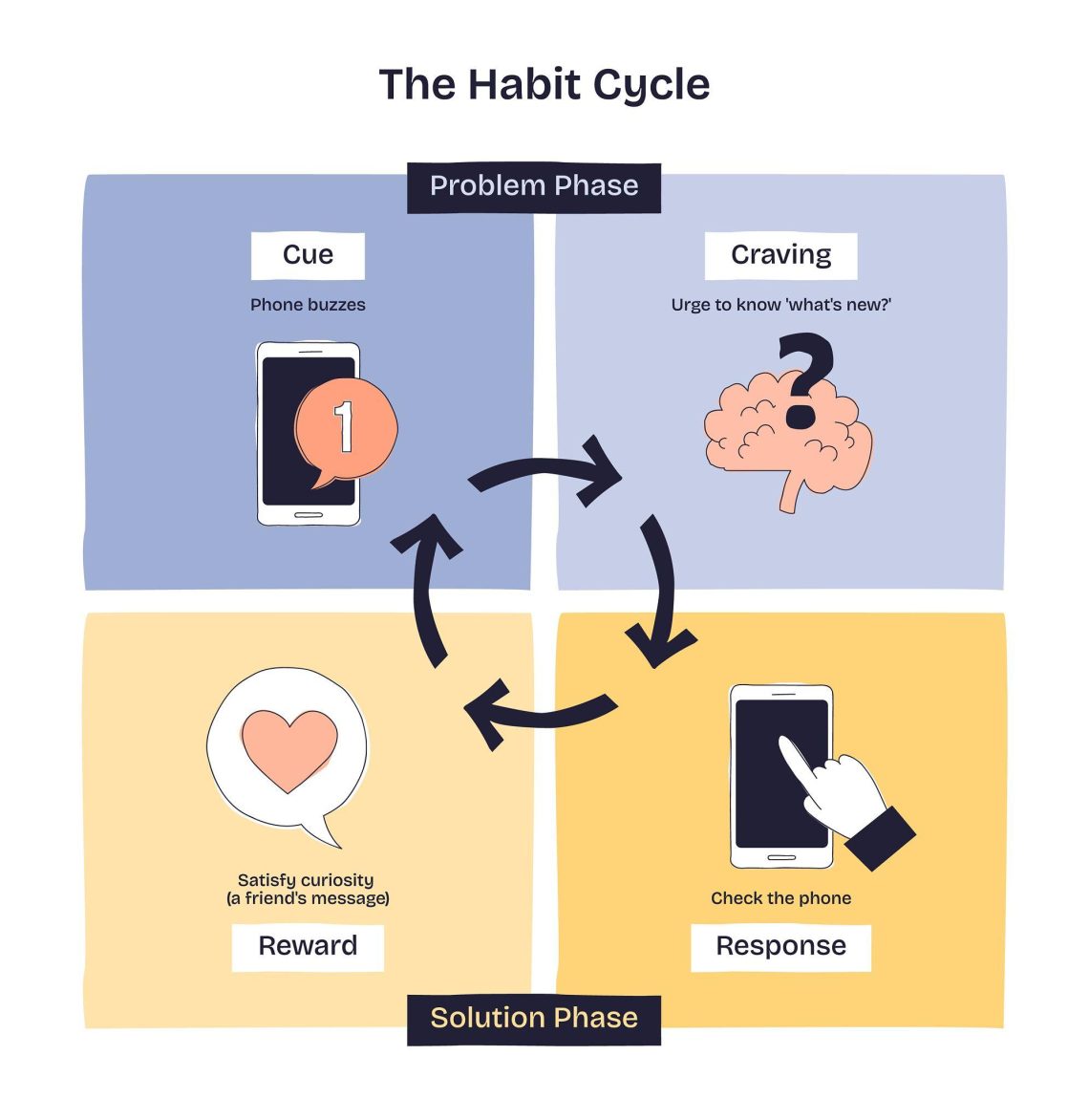
Habit formation follows a predictable pattern often called the habit loop: cue → routine → reward.
- Cue: A trigger that initiates the behavior. This might be a time of day, an emotional state, a location, or the presence of certain people.
- Routine: The behavior itself—what you do in response to the cue.
- Reward: The payoff that reinforces the behavior, teaching the brain that the routine is worth remembering.
Neuroplasticity underwrites this loop. Each time the loop completes, the neural connections involved become slightly stronger. The brain begins to anticipate the reward as soon as the cue appears, creating a craving that drives the behavior forward.
Importantly, the reward does not have to be obvious or even healthy. Relief from anxiety, distraction from boredom, or a brief hit of pleasure can all serve as powerful reinforcers. Over time, the brain learns not what is good for us, but what is reliably rewarding.
The Brain Systems Behind Habits
Two major brain systems play central roles in habit formation: the prefrontal cortex and the basal ganglia.

The prefrontal cortex is associated with planning, decision-making, and self-control. When you consciously decide to start a new habit—exercising regularly, meditating, or writing each morning—you are relying heavily on this region. It is flexible and powerful, but also metabolically expensive and easily fatigued.
The basal ganglia, by contrast, are deeply involved in automatic behaviors and routines. Once a habit is established, control shifts from the prefrontal cortex to these subcortical structures. The behavior becomes faster, more reliable, and less mentally taxing.
Neuroplasticity governs the transition between these systems. Repetition strengthens the neural circuits linking cues to routines in the basal ganglia. Eventually, the behavior requires little conscious thought, freeing the prefrontal cortex for other tasks.
This explains why willpower alone is a poor long-term strategy. Willpower lives in the prefrontal cortex. Habits live deeper. Sustainable change means designing behaviors that can be automated, not constantly fought for.
Positive Habits and Identity-Based Change
One of the most important insights from habit science is that habits are not just actions; they are expressions of identity. Each repetition is a small vote for the kind of person you are becoming.
This idea aligns closely with the concept of a growth mindset, popularized by Carol Dweck. When you believe that abilities and traits can be developed through effort and learning, you are more likely to persist in the behaviors that foster growth. Neuroplasticity provides the biological foundation for this belief.
Positive habits work best when they are framed not as chores, but as identity affirmations:
- I don’t just run; I am a runner.
- I don’t force myself to write; I am a writer.
- I don’t occasionally meditate; I am someone who practices mindfulness.
Each repetition strengthens not only neural pathways, but also self-concept. Over time, the habit feels less like something you do and more like something you are.
Small Changes, Big Effects: The Power of Incrementalism
One of the most persistent misconceptions about change is that it requires dramatic effort. In reality, the brain responds more reliably to small, consistent inputs than to sporadic intensity.
Neuroplastic changes occur gradually. Synapses strengthen incrementally. Networks reorganize step by step. This means that habits built on modest actions—five minutes of reading, one glass of water, a short walk—often outperform ambitious plans that rely on sustained motivation.
The popular habit literature emphasizes this point, notably in works like Atomic Habits, which argues that systems matter more than goals. From a neuroscience perspective, this makes sense. The brain learns through repetition, not aspiration. What matters is not how impressive the habit looks, but how consistently it fires the same neural circuit.
Emotion, Attention, and Plasticity
Not all repetition is equal. Neuroplasticity is strongly influenced by emotion and attention. Experiences that are emotionally salient or attentively engaged produce stronger neural changes than those that are passive or indifferent.
This has direct implications for habit formation:
- Emotion amplifies learning. Pairing a habit with positive emotion—satisfaction, pride, enjoyment—accelerates its consolidation.
- Attention sharpens plasticity. Mindless repetition is less effective than mindful practice, especially in the early stages of habit formation.
This is why celebrating small wins matters. Acknowledging progress releases dopamine, reinforcing the habit loop. Likewise, designing habits that are intrinsically enjoyable reduces reliance on external rewards.
Breaking Bad Habits: Plasticity Cuts Both Ways
If neuroplasticity allows us to build positive habits, it also explains why negative ones are so stubborn. Long-standing habits represent well-worn neural highways. They fire quickly and reliably, often before conscious awareness catches up.
Breaking a bad habit does not mean erasing a neural pathway. The brain rarely deletes old circuits entirely. Instead, change involves building a stronger alternative pathway that can compete with the old one.
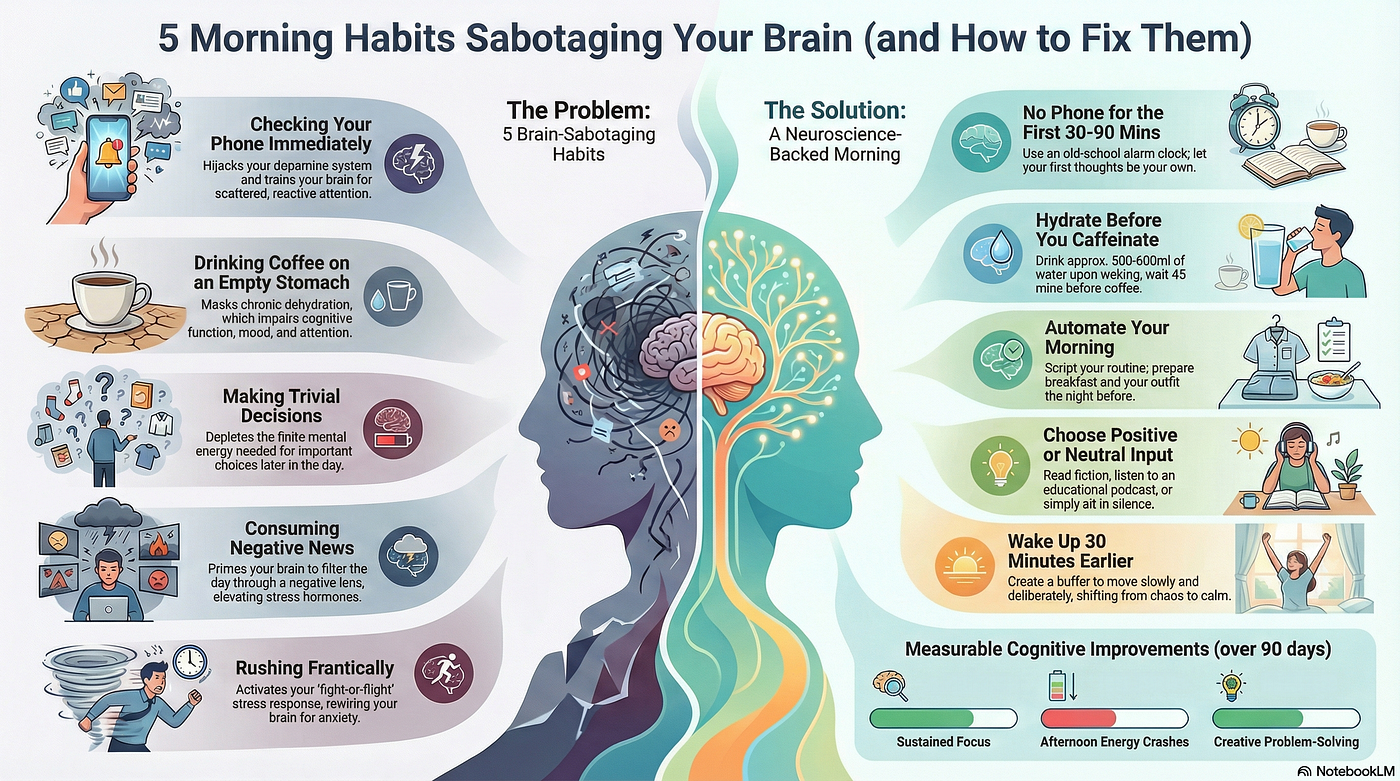
This is why replacement works better than suppression. Rather than trying to eliminate a behavior outright, effective change swaps the routine while keeping the cue and reward relatively constant. For example:
- Replacing stress eating with a short walk.
- Substituting social media scrolling with reading when bored.
- Trading evening alcohol for herbal tea and relaxation rituals.
Over time, the new routine can become the dominant response to the cue, reshaping the brain’s default patterns.
Environment as a Sculptor of the Brain
Because habits are cue-driven, environment plays a decisive role in neuroplastic change. The brain responds to what is easy, visible, and available.
Designing your environment to support positive habits is not a sign of weakness; it is an application of neuroscience. Removing friction for good habits and adding friction for bad ones shifts behavior without relying on constant self-control.
Examples include:
- Placing a book on your pillow to cue nighttime reading.
- Keeping healthy snacks visible and junk food out of sight.
- Setting up a dedicated workspace that signals focus.
Each environmental tweak subtly biases neural activity, nudging the brain toward certain patterns and away from others.
Long-Term Plasticity and Lifelong Growth
Perhaps the most encouraging aspect of neuroplasticity is its durability. While change is gradual, it can be remarkably persistent. Habits formed over months and years can last a lifetime, becoming part of the brain’s default operating system.
This also means that it is never too late to change. Learning a new skill, adopting a healthier routine, or reshaping emotional responses in midlife or later is not an act of denial; it is an act of alignment with how the brain actually works.
The brain you have today is, in large part, the sum of your past habits. The brain you will have tomorrow is being shaped by what you repeat today.
Conclusion: Becoming the Architect of Your Own Brain
Neuroplasticity turns self-improvement from a moral struggle into a biological process. Habits are not battles between willpower and weakness; they are negotiations with neural circuitry shaped by repetition, reward, and environment.
Positive habit formation works because it aligns with the brain’s natural tendencies. By starting small, repeating consistently, pairing actions with rewards, and designing supportive environments, you cooperate with neuroplasticity rather than fighting it.
In the end, habits are not about perfection. They are about direction. Each repetition is a quiet vote for the person you are becoming—and a tiny act of brain-building in that direction.

You May Also Like