Six Ways Brunelleschi’s Perspective Still Shapes Modern Life, Art, and Architecture
When Filippo Brunelleschi demonstrated linear perspective in early fifteenth-century Florence, he wasn’t just solving an artistic problem. He was offering a new way to organize reality itself—one that aligned space with human perception and mathematical order. What began as an experiment with mirrors and geometry became a quiet revolution whose effects still ripple through modern art, architecture, technology, and everyday visual culture.
Here are six enduring impacts of Brunelleschi’s concept of perspective—and why it still matters.
1. A New Way of Seeing the World
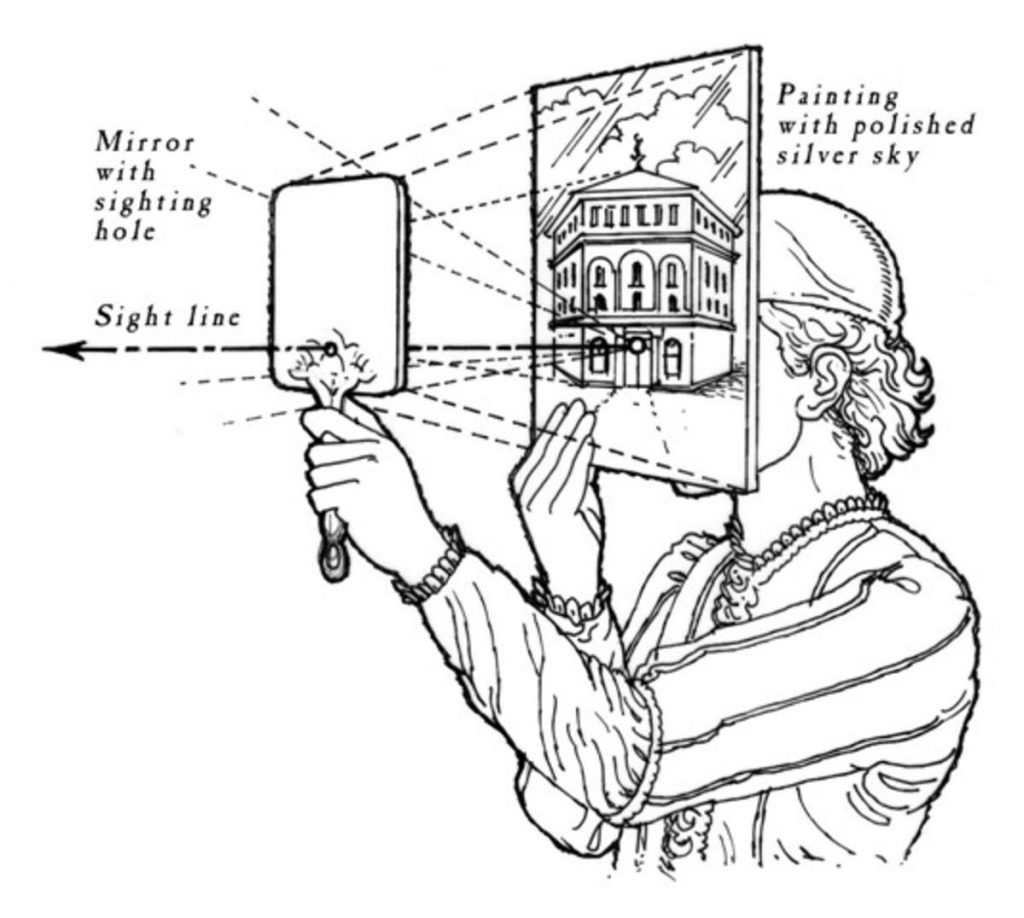
Brunelleschi’s most profound legacy is perceptual. Linear perspective taught Western culture to imagine space as something coherent, measurable, and unified around a single viewpoint. This was a radical departure from the symbolic, flattened spaces of medieval art.
Modern life is saturated with this assumption. From photographs to architectural renderings, we instinctively expect images to recede toward a vanishing point. Perspective trained our eyes to see the world as ordered and intelligible—an idea that underpins everything from scientific diagrams to city planning maps. Even when artists or designers reject perspective today, they do so with full awareness of its visual authority.
2. The Foundation of Realistic Visual Art
Nearly every tradition of Western realism rests on Brunelleschi’s insight. Painters of the Renaissance quickly adopted perspective to create convincing depth, allowing viewers to feel as though they were looking into a real, inhabitable space.
That expectation never went away. Modern illustration, advertising, concept art, and even graphic novels rely on perspective grids to create believable worlds. Whether it’s a movie poster, a video game environment, or a museum mural, Brunelleschi’s system quietly governs how realism is constructed—and judged—by modern audiences.
3. Architecture Designed for Human Experience
Perspective didn’t just change how buildings were drawn; it changed how they were conceived. Architects began to think about how structures would appear from specific vantage points—approaches, interiors, sightlines, and axes.

This legacy is visible in modern architecture and urban design. Grand boulevards, symmetrical civic spaces, and carefully framed vistas all rely on perspectival thinking. Even contemporary minimalist buildings, which may avoid ornament, are deeply concerned with how space unfolds as a person moves through it. Brunelleschi helped shift architecture from pure construction to spatial experience.
4. The Blueprint for Technical Drawing and Design
Perspective became the backbone of technical representation. Long before computer-aided design, architects, engineers, and designers depended on perspectival drawings to visualize projects before they were built.
Today’s CAD software, 3D modeling tools, and architectural visualizations are direct descendants of this logic. The ability to simulate objects and spaces accurately—whether designing a bridge, a chair, or a smartphone—depends on the same principles Brunelleschi formalized. Modern design culture, from industrial manufacturing to product UX mockups, still speaks his visual language.
5. The Visual Logic of Photography, Film, and Screens
Although Brunelleschi could never have imagined a camera or a smartphone, his perspective underlies both. Photography captures space according to a fixed viewpoint and converging lines—essentially automating linear perspective.
Cinema expanded this further. Directors compose shots using perspective to guide attention, convey power, or evoke intimacy. A long hallway shot, a city skyline, or a character framed at the end of a narrowing street all rely on perspectival depth to tell a story visually. Even virtual reality and video games, which allow movement within simulated worlds, are built upon perspective engines that trace their ancestry back to Renaissance geometry.
6. A World Ordered by Measurement and Control
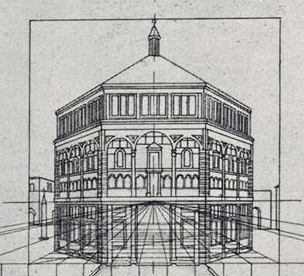
Perhaps the most far-reaching impact of Brunelleschi’s perspective is philosophical. By aligning vision with mathematics, perspective reinforced the idea that the world could be measured, predicted, and mastered through rational systems.
This mindset influenced the Scientific Revolution, modern engineering, and contemporary data visualization. Charts, graphs, and spatial models all reflect the belief that complex realities can be rendered understandable through structured visual systems. Perspective didn’t just depict the world—it helped convince us that the world itself is fundamentally knowable.
Why Brunelleschi Still Matters
Brunelleschi’s achievement wasn’t merely technical; it was cultural. He offered a framework that placed human perception at the center of spatial understanding while binding it to mathematical precision. That fusion continues to shape how we build, design, represent, and even imagine reality.
In an age of digital environments and artificial worlds, perspective remains our default visual grammar. Every time a space feels “right,” a scene looks “real,” or a design seems intuitively navigable, we are—knowingly or not—seeing through Brunelleschi’s eyes.
And that may be his greatest legacy: not that he taught us how to draw space, but that he taught us how to trust what we see.
