The Colonial History of Pennsylvania, 1681–1775
You may also be interested in our posts on the colonial history of Virginia and Massachusetts.
When King Charles II granted a vast tract of land in North America to William Penn in 1681, few could have predicted that this new colony would become one of the most influential societies in British America. Pennsylvania emerged not only as a haven for religious dissenters but also as an economic powerhouse, a center of intellectual life, and ultimately a crucible of revolutionary ideas. Between its founding and the eve of the American Revolution in 1775, Pennsylvania developed a distinctive political culture that blended tolerance, prosperity, and a growing insistence on liberty.
This history is not simply a story of peaceful settlement or inevitable rebellion. It is a complex narrative shaped by ideals and contradictions—between pacifism and frontier violence, proprietary authority and popular self-government, loyalty to the Crown and resistance to imperial control. Understanding colonial Pennsylvania helps explain why the colony played such a central role in the American founding.
William Penn’s “Holy Experiment”
Pennsylvania began as a bold vision. William Penn, a prominent English Quaker and political thinker, envisioned a colony grounded in religious freedom, just laws, and peaceful relations with Native Americans. The land grant, issued in 1681, served both as repayment of a royal debt to Penn’s father and as an opportunity for Penn to realize what he called a “Holy Experiment.”
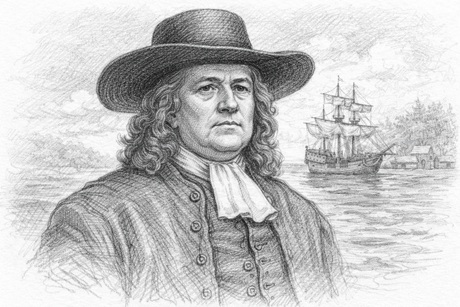
Unlike many other colonies founded for commercial or strategic reasons, Pennsylvania was conceived as a moral and political project. Penn believed that government should protect liberty of conscience and exist by the consent of the governed. These ideas were laid out in the colony’s early constitutional documents, especially the Frame of Government of Pennsylvania (1682), which established an elected assembly and guaranteed religious toleration for monotheists.
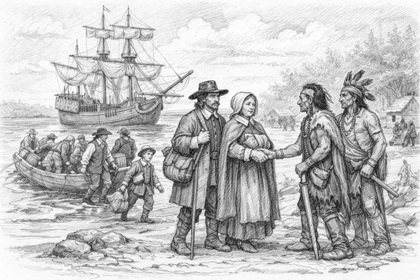
Penn’s approach to Native Americans was equally distinctive. Rather than seizing land by force, he negotiated treaties with the Lenape (Delaware) people, famously promising that Quakers and Native peoples would live together “as long as the rivers run and the sun shines.” While later generations would betray this ideal, Penn’s early policies fostered decades of relatively peaceful coexistence.
Founding Philadelphia and Early Settlement
Penn arrived in the colony in 1682 and quickly set about organizing its growth. He selected a site along the Delaware River for a new capital city, naming it Philadelphia, meaning “City of Brotherly Love.” Designed on a grid plan with wide streets and public green spaces, Philadelphia reflected Penn’s belief in order, health, and civic virtue.
The colony attracted a remarkably diverse population. English Quakers formed the core of early leadership, but they were soon joined by Germans (often called “Pennsylvania Dutch”), Welsh, Scots-Irish Presbyterians, Mennonites, Moravians, Lutherans, and others. Many came fleeing religious persecution or economic hardship in Europe; others were drawn by the promise of affordable land and political participation.
This diversity distinguished Pennsylvania from more homogenous colonies such as Puritan Massachusetts or Anglican Virginia. By the early eighteenth century, Pennsylvania had become one of the most pluralistic societies in the Atlantic world—a fact that shaped its politics, culture, and future conflicts.
Government and the Limits of Proprietary Rule
Although Pennsylvania offered broad political participation, it was not a democracy in the modern sense. The colony was a proprietary province, meaning it was owned by Penn and his heirs, who retained significant authority over land distribution, appointments, and legislation. This arrangement soon generated tension.
The elected Assembly frequently clashed with the Penn family over taxation, defense, and control of government offices. Assemblymen, many of whom were not Quakers, resented proprietary privileges and demanded greater accountability. These disputes intensified after Penn’s death in 1718, as his heirs proved less flexible and more interested in protecting their economic interests.
Despite these conflicts, Pennsylvania developed a strong tradition of legislative resistance. The Assembly asserted the right to control taxation and spending, laying early groundwork for later colonial opposition to British parliamentary authority. In this sense, Pennsylvania’s internal political struggles trained its leaders in the language and practice of constitutional resistance.
Religious Tolerance and Social Experimentation
One of Pennsylvania’s most enduring legacies was its commitment to religious liberty. While other colonies enforced established churches or religious tests for officeholding, Pennsylvania allowed freedom of worship to a wide range of Christian denominations. This policy was not merely pragmatic; it reflected Quaker theology, which emphasized the “Inner Light” and rejected coercion in matters of faith.
The result was a vibrant religious landscape. German Pietists founded communal settlements, Moravians established missions, and Presbyterians built institutions that would later shape American education. Religious diversity encouraged cooperation across denominational lines, but it also produced competition and occasional conflict, particularly as new immigrant groups poured into the colony.
This tolerance fostered a broader culture of intellectual openness. Pennsylvania became a center for printing, scientific inquiry, and public debate. These developments helped make the colony unusually receptive to Enlightenment ideas and political reform.
Economic Growth and the Rise of a Middle Colony Powerhouse
Pennsylvania’s economic success was driven by geography and policy. Fertile soil supported grain production on a massive scale, earning the colony the nickname “the breadbasket of the colonies.” Wheat, flour, and other agricultural products flowed through Philadelphia’s busy port to the Caribbean and Europe.
Trade and manufacturing flourished alongside agriculture. Artisans, merchants, and shipbuilders found opportunity in the growing urban economy. Unlike plantation colonies dependent on enslaved labor, Pennsylvania’s economy rested largely on small farms and family labor, though slavery did exist and played a significant role, particularly in Philadelphia.
By the mid-eighteenth century, Pennsylvania was one of the wealthiest and most populous colonies in British America. This prosperity supported a growing middle class that valued education, civic engagement, and political influence—key ingredients in the colony’s later revolutionary activism.
Slavery, Freedom, and Moral Contradictions
Despite its reputation for tolerance, Pennsylvania was not free from injustice. Enslaved Africans were present from the colony’s earliest years, and by the early 1700s slavery was firmly established, especially in urban households and farms near Philadelphia.
Yet Pennsylvania also became a center of early antislavery thought. Quakers increasingly condemned slavery as incompatible with their faith, and in 1688 German Quakers in Germantown issued one of the first formal protests against slavery in the English-speaking world. By the mid-eighteenth century, Quaker meetings began disciplining members who owned slaves.
This tension between economic practice and moral conviction reflected broader contradictions in colonial society. Pennsylvania’s gradual movement toward abolition would later culminate in the state’s landmark gradual emancipation law of 1780, but the roots of that transformation lay in the colonial period.
Frontier Expansion and Conflict
As settlers moved westward beyond the settled eastern counties, Pennsylvania’s commitment to peace faced severe challenges. Scots-Irish immigrants, often settling on the frontier, clashed with Native American groups over land and resources. These conflicts intensified during imperial wars between Britain and France.
The most devastating of these was the French and Indian War (1754–1763). Pennsylvania’s Quaker-dominated Assembly initially resisted funding military defense, consistent with pacifist principles. Frontier communities, however, demanded protection, leading to deep political divisions within the colony.
Violence reached a grim peak with events such as the Paxton Boys’ massacre of peaceful Conestoga Indians in 1763. These incidents exposed the limits of Pennsylvania’s early ideals and underscored the growing rift between eastern elites and western settlers.
The Enlightenment and Pennsylvania’s Intellectual Life
No figure better represents Pennsylvania’s intellectual vibrancy than Benjamin Franklin. Arriving in Philadelphia as a young printer, Franklin rose to become a leading scientist, writer, and civic reformer. His career illustrates how Pennsylvania’s open society enabled social mobility and innovation.
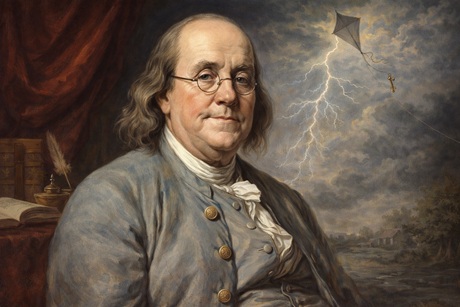
Franklin and his contemporaries founded institutions that embodied Enlightenment values: libraries, scientific societies, hospitals, and schools. The American Philosophical Society and the Academy of Philadelphia (later the University of Pennsylvania) became centers of learning with transatlantic influence.
This intellectual culture encouraged critical thinking about authority, tradition, and governance. By the 1760s, Pennsylvania’s citizens were well prepared to engage with revolutionary arguments about rights and liberty.
Imperial Crisis and Political Radicalization
After 1763, Britain sought to tighten control over its American colonies, imposing new taxes and regulations to pay for imperial defense. Measures such as the Stamp Act and Townshend Duties met fierce resistance in Pennsylvania, particularly in Philadelphia, where merchants, printers, and artisans mobilized public opinion.
Pennsylvania’s political culture shaped its response to imperial crisis. Long experience resisting proprietary authority made colonists skeptical of distant power. Pamphlets, newspapers, and public meetings became tools of protest, and organizations such as committees of correspondence emerged to coordinate resistance.
While Pennsylvania initially pursued moderation and reconciliation, events such as the Boston Tea Party and the Coercive Acts radicalized opinion. By the early 1770s, calls for independence grew louder, even as loyalist sentiment persisted among some Quakers and merchants.
Pennsylvania on the Eve of Revolution
By 1775, Pennsylvania stood at a crossroads. It was the most populous and economically powerful of the middle colonies, home to a diverse population and a tradition of political debate. Its capital, Philadelphia, would soon host the Continental Congress and become the nerve center of the revolutionary movement.
Yet Pennsylvania’s path to revolution was cautious and contested. Internal divisions—between pacifists and militants, elites and frontier settlers, loyalists and radicals—meant that independence was neither inevitable nor universally embraced. What unified Pennsylvanians, however, was a deep attachment to liberty, local self-government, and the belief that authority must rest on consent.
These values, cultivated over nearly a century of colonial experience, would soon be tested in war and revolution.
Conclusion: The Legacy of Colonial Pennsylvania
The colonial history of Pennsylvania from 1681 to 1775 is a story of ideas put into practice—and often into conflict. William Penn’s Holy Experiment created a society unlike any other in British America, one defined by tolerance, prosperity, and political engagement. Over time, the colony’s diversity and openness nurtured both creativity and tension, producing a population keenly aware of its rights and responsibilities.
Pennsylvania’s experience helps explain why the American Revolution was not merely a reaction to British policies but the culmination of long-standing colonial traditions. By the time shots were fired at Lexington and Concord, Pennsylvanians had already spent generations debating liberty, governance, and justice. The revolution would transform those debates into action, but their roots lay firmly in the colonial past.


You May Also Like
From Lost Colonies to Revolutionary Province: The Colonial History of North Carolina, 1585–1775
Maryland: A Colonial Experiment, 1634–1775