Review: Carved in Stone by John A. Cowgill
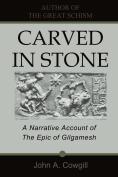
John A. Cowgill’s Carved in Stone: A Narrative Account of the Epic of Gilgamesh is not merely a retelling of humanity’s oldest surviving epic; it is a philosophical meditation disguised as mythic narrative. While many modern adaptations of Gilgamesh aim for literary clarity or academic fidelity, Cowgill’s work pursues a different ambition altogether. He seeks to interpret the epic as a symbolic map of human transformation — psychological, spiritual, and existential — and to situate that map within a sweeping comparative framework that ranges from alchemy and Christian theology to Jungian psychology and world folklore.
This is not a neutral translation, nor does it pretend to be. Carved in Stone is an interpretive act, and Cowgill is forthright about his intentions. From the opening Prologue, the book announces itself as an exploration of legacy, permanence, and the human compulsion to “etch” meaning into a transient life. The image of stone — as material, metaphor, and spiritual catalyst — is not ornamental. It is the organizing principle of the entire work.
Structure: Two Journeys, One Transformation
Cowgill divides the narrative into three major movements: the physical hero quest (the journey to the Land of Cedars), the unification of the outer and inner journeys, and the metaphysical quest beyond the Flood. This structure mirrors Joseph Campbell’s monomyth but with an explicitly dualistic emphasis. Gilgamesh’s battles are not simply feats of strength; they are stages in an interior process of integration.
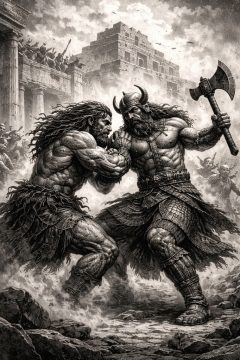
Part I, covering Gilgamesh’s tyranny, the creation and civilizing of Enkidu, and the battle with Humbaba, is rendered with muscular, repetitive prose that mimics oral storytelling. Cowgill’s diction is deliberately incantatory. Phrases recur, rhythms loop back on themselves, and actions are narrated in broad, symbolic strokes. This stylistic choice reinforces the mythic register of the tale while also foregrounding the idea that repetition itself is a form of carving — meaning is made by returning again and again to the same shapes.
Enkidu’s transformation through Shamhat is particularly telling. Cowgill does not shy away from the erotic force of the episode, nor does he sanitize its symbolism. Sexual union is framed explicitly as a civilizing and alchemical act, a motif Cowgill later connects to sacred feminine imagery and the transformation of base matter into gold. This is consistent with the book’s broader thesis: human growth requires union — of wild and civilized, masculine and feminine, conscious and unconscious.
Myth as Comparative Symbol System
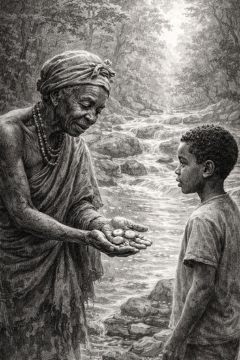
One of the most distinctive features of Carved in Stone is the extensive Prologue, which functions less as an introduction to Gilgamesh than as a comparative mythology essay. Cowgill ranges widely, invoking Nigerian folklore, medieval alchemy, Christian scripture, Jewish mysticism, Nietzsche, and Carl Jung (implicitly, if not always by name). At times, this section feels almost like a standalone treatise on mythic symbolism, with Gilgamesh serving as its gravitational center rather than its exclusive subject.
This approach will divide readers. Those looking for a streamlined narrative may find the Prologue expansive to the point of digression. Yet thematically, it establishes the lens through which the epic should be read: stone as philosopher’s stone, Christ as cornerstone, mercury as messenger, and transformation as the true object of heroic striving. Gilgamesh is not just a king; he is Everyman, engaged in the same futile and noble attempt to defeat death through meaning.
Cowgill’s integration of alchemical symbolism is particularly effective. The repeated emphasis on mercury as both substance and messenger parallels Enkidu’s role as intermediary between wilderness and civilization, just as Shamhat mediates between instinct and order. These are not casual parallels; they are sustained and deliberate, and they shape how the reader understands the epic’s events.
Language and Narrative Voice
Cowgill’s prose is intentionally archaic in cadence but modern in clarity. He employs repetition, direct address (“Dear Reader”), and declarative statements that echo biblical and epic traditions. This voice creates intimacy while maintaining grandeur. The effect is that the reader is not merely observing the story but being initiated into it.
At its best, this style is hypnotic. The dream sequences before the battle with Humbaba, for instance, are some of the strongest passages in the book. Enkidu’s repeated reassurance — “I was a wild man, so I know this dream; and it is good” — reframes fear as misinterpreted knowledge. Dreams are not warnings to retreat but symbolic confirmations of inevitable transformation.
However, the same stylistic commitment occasionally becomes a limitation. Some passages lean so heavily into repetition that narrative momentum stalls. The prose prioritizes resonance over economy, which may frustrate readers accustomed to tighter pacing.
Gilgamesh, Enkidu, and the Ethics of Heroism
Cowgill presents Gilgamesh not as a static hero but as a morally unfinished one. His early abuses of power are neither excused nor sensationalized; they are treated as symptoms of an unintegrated psyche. Enkidu’s arrival is thus not merely companionship but correction — a necessary counterweight to unchecked authority.
Their friendship is the emotional core of the book, and Cowgill treats it with unusual seriousness. When Enkidu later dies, the loss is not just personal but cosmological. The world has lost its balance. Gilgamesh’s subsequent quest for immortality is framed as grief-driven desperation, not enlightened seeking. This reading aligns closely with the psychological interpretation Cowgill advances throughout the text: denial of death leads to fragmentation, not transcendence.
The gods, too, are rendered less as moral arbiters than as forces representing natural and psychological laws. Inanna’s rage, Anu’s caution, and Shamash’s conditional support all reinforce the idea that divine forces respond to human imbalance rather than ethical violation per se.
Seen and Unseen: Psychology Enters the Epic
The Interlogue, “Seen and Unseen,” marks a decisive turn toward explicit psychological interpretation. Cowgill invokes Freud and Enlightenment positivism to argue that modernity’s rejection of unseen realities impoverishes our understanding of myth. This section reads almost like a manifesto: myth is not false history but symbolic truth, and Gilgamesh endures because it articulates truths science alone cannot.
This is where Cowgill’s ambitions are clearest — and riskiest. The synthesis of myth, religion, and psychology is intellectually rich, but it assumes a reader willing to follow long associative chains. Some may find the argument persuasive and invigorating; others may feel the book overdetermines the epic by forcing it into a particular philosophical framework.
Final Assessment
Carved in Stone is not a casual introduction to Gilgamesh, nor is it a scholarly edition. It is a mythopoetic interpretation — personal, symbolic, and unapologetically synthetic. Cowgill invites readers to encounter the epic not as an artifact of ancient Mesopotamia alone, but as a living narrative that continues to shape how humans understand fear, friendship, death, and legacy.
Its greatest strength is its seriousness of purpose. Cowgill believes that myths matter — not metaphorically, but existentially — and he writes accordingly. The book asks readers to slow down, to dwell in symbols, and to accept that some truths are only accessible through story.
Readers seeking academic restraint or minimalist prose may struggle with its scope and density. But for those interested in mythology as a vehicle for psychological and spiritual reflection, Carved in Stone offers a deeply considered and often moving engagement with one of humanity’s foundational stories.
In the end, Cowgill succeeds in what his title promises: he does not simply recount Gilgamesh’s deeds; he carves an interpretation into stone, knowing full well that others may carve differently — and trusting that the act of carving itself is what keeps the story alive.


You May Also Like
Learning to Release What No Longer Serves You: A Review of The Art of Letting Go