Paul Revere and the World He Lived In: History Beyond the Midnight Ride
A review of a classic history text and its author, Esther Forbes
Few figures in American history are as instantly recognizable—and as poorly understood—as Paul Revere. Reduced in popular memory to a single dramatic night, he often appears less as a historical person than as a patriotic symbol. Esther Forbes’s Paul Revere and the World He Lived In, first published in 1942 and awarded the Pulitzer Prize for History, decisively dismantles that simplification. What Forbes offers is not merely a biography, but a richly textured portrait of eighteenth-century New England, seen through the life of one man who was deeply embedded in its political, economic, and social currents.
This book endures because it does something many historical biographies fail to do: it restores context. Forbes insists that Revere cannot be understood apart from the world that shaped him, and she reconstructs that world with exceptional clarity, warmth, and intelligence.
Reclaiming Paul Revere from Legend
One of Forbes’s central achievements is her demythologizing of Paul Revere without diminishing his importance. She neither worships nor dismisses him. Instead, she presents Revere as a skilled craftsman, a committed patriot, a family man, and—crucially—a political actor whose influence grew gradually rather than explosively.
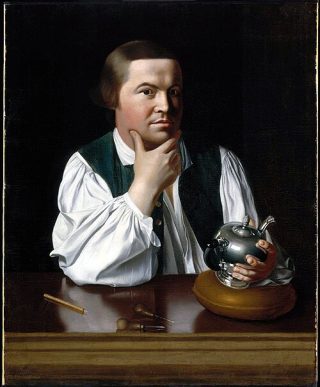
Revere was a silversmith by trade, not an elite gentleman or professional revolutionary. Forbes devotes significant attention to the artisan class of colonial Boston, showing how craftsmen like Revere occupied a crucial middle ground between laborers and the colonial elite. This social position shaped Revere’s politics: he was close enough to power to understand it, yet excluded enough to resent its abuses.
By placing Revere among his peers—printers, shipbuilders, merchants, and fellow artisans—Forbes shows that the American Revolution was not simply an intellectual movement driven by famous pamphlets, but a lived experience rooted in economic pressure, communal networks, and local loyalties.
The World He Lived In: Colonial Boston as a Character
The true protagonist of the book may well be Boston itself. Forbes reconstructs the city as a living organism: crowded, noisy, politically volatile, and socially intimate. She describes how news traveled through taverns and workshops, how rumors gained traction, and how resistance to British authority developed not in abstraction, but through repeated, personal confrontations.
Taxation, trade restrictions, and military occupation are not treated as distant policies but as daily intrusions into ordinary life. Forbes carefully explains how British decisions affected prices, employment, and neighborhood stability. In doing so, she makes clear why resistance was not inevitable, but understandable.
This attention to everyday experience is one of the book’s greatest strengths. Readers come away with a vivid sense of how history feels while it is happening—confusing, uncertain, and morally ambiguous—rather than how it appears in retrospect.
Politics Without Romanticism
Although Forbes clearly admires the patriot cause, she resists romanticizing it. Revolutionary politics, as she presents them, are messy and often uncomfortable. Committees of correspondence operate in legal gray areas. Popular protests blur into intimidation. Loyalty and betrayal are not always cleanly separated.
Revere himself is shown navigating these tensions. He participates in intelligence gathering, message delivery, and political organization, but he is not always certain of outcomes or motives. Forbes does not portray him as a flawless hero, but as a man trying to act responsibly under extraordinary pressure.
This restraint gives the book moral credibility. Forbes allows readers to see the Revolution as a human process rather than a moral fable—one shaped by fear, hope, compromise, and conviction.
Craftsmanship, Labor, and Identity
Another remarkable aspect of the book is its sustained attention to work. Forbes treats Revere’s silversmithing not as background detail but as central to his identity. His craftsmanship provides financial independence, social standing, and a network of relationships that later prove politically significant.
In an era when historical writing often focused almost exclusively on elites, Forbes’s decision to foreground labor is quietly radical. She shows how skill, pride in work, and economic self-sufficiency fostered a sense of personal dignity that translated into political resistance.
Revere’s later ventures into iron casting and manufacturing further underscore this theme. He was not simply a revolutionary messenger but an early American industrialist, adapting to changing economic realities in the new republic.
Style and Historical Method
Forbes’s prose is one of the book’s most enduring pleasures. She writes with elegance and narrative momentum, but never at the expense of accuracy. Her descriptions are vivid without being indulgent, and her explanations are clear without oversimplifying complex issues.
Importantly, Forbes integrates historical research seamlessly into the narrative. Letters, records, and contemporary accounts are woven into the story rather than presented as academic apparatus. This makes the book accessible to general readers while maintaining scholarly seriousness.
The result is a work that feels alive—closer to a historical novel in readability, yet firmly grounded in evidence.
Why the Book Still Matters
More than eighty years after its publication, Paul Revere and the World He Lived In remains essential reading not only for students of the American Revolution, but for anyone interested in how history actually unfolds. Forbes teaches us to look beyond slogans and symbols, to examine the social structures and economic pressures that shape political action.
At a time when public discourse often reduces history to moral shorthand, this book is a reminder that understanding requires patience, nuance, and empathy. Revere’s world was not simple, and neither is ours. Forbes’s great accomplishment is to show that complexity is not an obstacle to meaning—it is the source of it.
Final Assessment
Paul Revere and the World He Lived In is far more than a biography of a famous patriot. It is a study in how ordinary lives intersect with extraordinary events, and how revolutions are built not only by ideas, but by communities, labor, and circumstance.
Esther Forbes restores Paul Revere to history by placing him firmly within it—no longer a solitary rider in the night, but a man shaped by his world and, in turn, helping to reshape it. For readers who want to understand the American Revolution as a lived experience rather than a legend, this book remains unmatched.

You May Also Like
The History of the Virginia Colony, 1607–1775
Another Look at Roanoke